



News Details
international webinar “From Convention to Implementation: the experience of Personal Assistance Models in Europe and the Ibero-American Area”
Updated : 05/06/2026
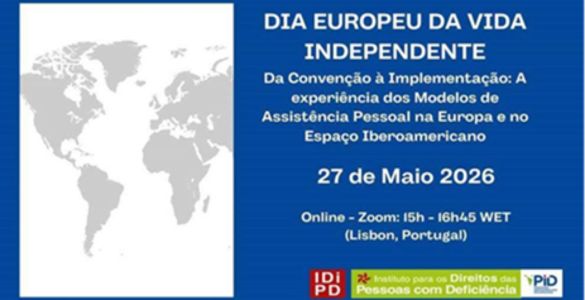
The Institute for the Rights of Persons with Disabilities, IP (IDiPD, IP), in co-organisation with the Ibero-American Program on the Rights of Persons with Disabilities (PID), promoted on 27 May the international webinar “From Convention to Implementation: the experience of Personal Assistance Models in Europe and the Ibero-American Area” as part of the celebrations of the European Day of Independent Living.
The initiative brought together institutional representatives, international experts, European bodies and public entities from various Ibero-American and European countries, with around 300 participants, and its main objective was to promote reflection and the sharing of experiences on independent living models, personal assistance and deinstitutionalisation processes, in line with the United Nations Convention on the Rights of Persons with Disabilities, in particular Article 19.º.
At the opening session, the President of the Ibero-American Program on the Rights of Persons with Disabilities, Jesús Martín, highlighted personal assistance as an essential tool to ensure freedom of choice, autonomy and full participation in the community. The Secretary of State for Social Action and Inclusion, Clara Marques Mendes, reaffirmed the Portuguese Government's commitment to promoting the autonomy and self-determination of people with disabilities, highlighting the implementation of the Independent Living Support Model (MAVI) in Portugal, currently implemented through 35 Independent Living Support Centres (CAVI) and covering around 1,200 beneficiaries.
Throughout the webinar, the main challenges and opportunities associated with the implementation of personal assistance and independent living models were discussed, and the need to strengthen community services, ensure adequate funding, promote deinstitutionalisation and consolidate public policies focused on human rights was highlighted.
International expert Amalia Gamio Ríos highlighted the distinction between welfare models and personal assistance based on human rights, arguing that it should be directed by the person with disabilities themselves, respecting their individual choices and promoting autonomy and dignity.
In the European context, Hayden Hammersley, representative of the European Disability Forum, warned of the persistence of institutionalisation in the European Union, underlining the need to strengthen investment in personal assistance, affordable housing and community services.
The webinar also integrated the presentation of international experiences developed in Portugal, Costa Rica, Slovenia and Spain, highlighting different models and approaches in the promotion of independent living. The interventions identified common challenges, including the need to extend the territorial coverage of support, strengthen the training of personal assistants and promote more personalised responses focused on the autonomy of persons with disabilities.
At the closing session, the Chair of the Governing Board of IDiPD, IP, Sónia Esperto, underlined the importance of international cooperation and sharing best practices as key tools for developing more inclusive, sustainable public policies aligned with the principles of the UN Convention on the Rights of Persons with Disabilities.
The webinar is available for viewing here IDiPD's official YouTube channel.